Invest in the Future with PLLD Tokens

Sustainable Tokenomics for Continuous Growth

Transparent hard capped supply, vesting, buybacks, and burns. Track allocations and on-chain transactions in one place.

Palladium Tokenomics

Tokenomics Allocation

Palladium Tokenomics Info

Palladium’s native token, PLLD, launched with an initial supply of 100,000,000 PLLD. After structured burn events totaling 47,357,000 PLLD, the effective supply has been reduced to 52,643,000 PLLD. Additional periodic burns are planned until the supply reaches the long-term target of 30,000,000 PLLD. The table below shows the current post-burn adjusted supply based on the original allocation ratios.

Allocation Category Genesis % Genesis Allocation Current % Current Allocation
Liquidity Provision 30% 30,000,000 PLLD 5.58% 2,938,857 PLLD
Public Sale 20% 20,000,000 PLLD 3.72% 1,959,238 PLLD
Development 20% 20,000,000 PLLD 37.98% 20,000,000 PLLD
Team and Advisors 10% 10,000,000 PLLD 19.00% 10,000,000 PLLD
Treasury Reserve 10% 10,000,000 PLLD 19.00% 10,000,000 PLLD
Marketing 10% 10,000,000 PLLD 14.72% 7,744,905 PLLD
Total 100% 100,000,000 PLLD 100% 52,643,000 PLLD
Palladium Burn
burn

Palladium Burn

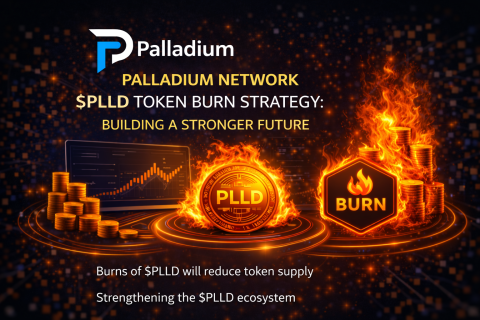
Palladium uses a structured, transparent token burning program alongside buybacks to gradually reduce supply and better align circulating PLLD with platform growth. In general, burns are a common tokenomics tool: by permanently removing tokens, projects can reinforce scarcity and improve long-term supply discipline.

As of November 2025, 47,357,000 PLLD has been permanently removed from circulation. The long-term objective is a maximum supply of 30,000,000 PLLD, balancing scarcity with enough liquidity for trading, staking, and real-estate participation.

Burns occur at least once per year (and may happen more often based on profits, milestones, or treasury actions). Every burn is verifiable on-chain, with tokens sent to the Ethereum “dead” (Null) address and accompanied by published reports showing transaction references, totals, and updated supply. A well-known example is BNB, which uses an automated burn model and has remained one of the stronger-performing large-cap ecosystems over time—though performance always depends on broader market and adoption factors.

Transaction History

The table below lists the key on-chain transactions that shape PLLD supply and distribution. It includes major events such as genesis minting, burns, vesting releases, treasury movements, and other supply-affecting actions.

Each entry links to its block and transaction hash for independent verification, so you can track totals over time and confirm every update directly on-chain.

Date Block Tx Hash Type Amount
Nov-15-2025 23805470 0x3d.....de Burn -47,200,000 PLLD
Nov-13-2025 23792354 0x70.....dd Burn -157,000 PLLD
Jul-23-2025 22982425 0xe2.....c5 Reward 1,000,000 PLLD
Jun-30-2025 22819930 0xbe.....b7 Buyback 12,857.74 PLLD
Jun-06-2025 22645458 0x2e.....65 Buyback 21,548.10 PLLD
Jun-05-2025 22640531 0xaf.....ae Buyback 10,251.58 PLLD
Jun-03-2025 22622824 0xfe.....a5 Vest 20,000,000 PLLD
Jun-03-2025 22622869 0xa2.....12 Vest 10,000,000 PLLD
Jun-03-2025 22622899 0x80.....00 Vest 10,000,000 PLLD
Jun-03-2025 22625401 0xb4.....57 Vest 7,500,000 PLLD
May-20-2025 22526852 0x4c.....e4 Buyback 112,332.90 PLLD
May-20-2025 22526673 0xa4.....d2 Buyback 9.90 PLLD
Apr-24-2025 22341309 0xf9.....a1 Mint 100,000,000 PLLD

All figures are sourced from on-chain data and update as new transactions appear.