What Is Self-Custody?
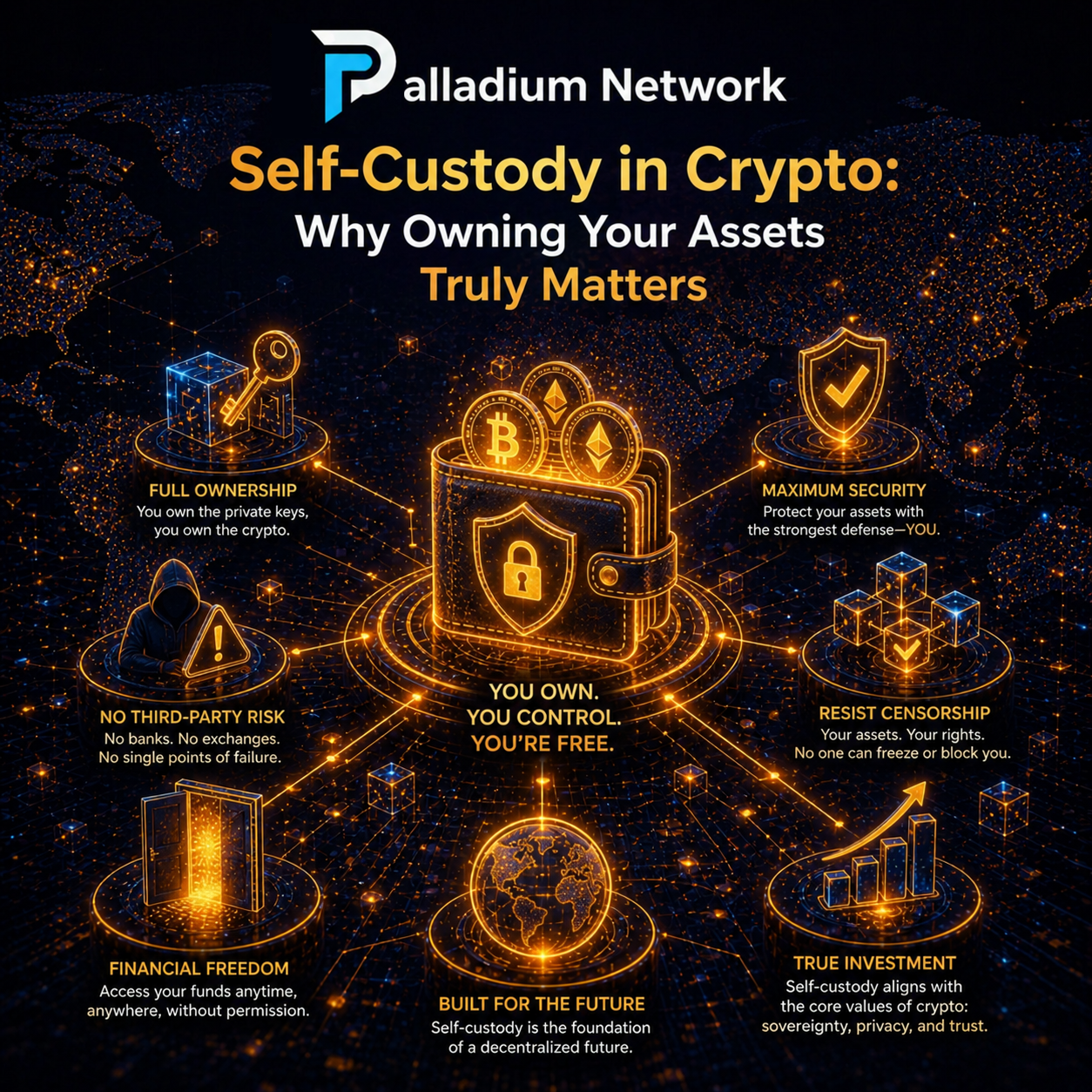
Self-custody means that you hold your own private keys, giving you full control over your digital assets.
Unlike traditional banking systems—or even centralized crypto exchanges—self-custody ensures that:
- You are the sole owner of your funds
- No third party can freeze or restrict access
- Transactions are fully under your control
In simple terms: not your keys, not your crypto.
Why It Matters More Than Ever
Recent years have shown that relying entirely on third parties can introduce significant risks. Platform failures, withdrawal freezes, and security breaches have highlighted the importance of taking control of your assets.
Self-custody eliminates many of these risks by removing intermediaries from the equation.
Key benefits include:
1. True Ownership
You are not trusting a platform—you directly control your funds on the blockchain.
2. Censorship Resistance
No authority can block or reverse your transactions.
3. Global Access
Your assets are accessible from anywhere in the world, at any time.
4. Increased Security (When Done Correctly)
By managing your own keys, you reduce exposure to centralized points of failure.
The Responsibility Trade-Off
Self-custody is powerful—but it comes with responsibility.
When you control your assets, you are also responsible for:
- Safely storing your private keys or seed phrase
- Avoiding phishing attacks and scams
- Ensuring proper backup and recovery methods
Unlike traditional systems, there is no “forgot password” option. Losing access to your keys can mean permanently losing your funds.
The Rise of User-Friendly Wallets
One of the biggest barriers to self-custody has been usability. However, this is rapidly improving.
Modern wallets now offer:
- Simplified interfaces
- Biometric authentication
- Social recovery mechanisms
- Enhanced security features
These innovations are making self-custody more accessible to everyday users—not just technical experts.
Self-Custody and the Future of Finance
Self-custody is not just about holding assets—it’s about redefining financial ownership.
As decentralized finance (DeFi), tokenized assets, and Web3 applications continue to grow, self-custody becomes the gateway to participating in this new ecosystem.
It enables users to:
- Interact directly with decentralized applications
- Maintain full control over digital identity and assets
- Participate in governance and on-chain economies
Finding the Right Balance
While self-custody offers unmatched control, many users adopt a hybrid approach:
- Centralized platforms for convenience and onboarding
- Self-custody wallets for long-term storage and control
This balanced strategy allows users to benefit from both accessibility and security.
Conclusion
Self-custody represents one of the most important shifts introduced by cryptocurrency.
It transforms users from passive participants into true owners of their wealth, removing reliance on intermediaries and giving control back to individuals.
As the crypto ecosystem continues to evolve, self-custody will remain a cornerstone of its philosophy—empowering users to take full control of their financial future.
Disclaimer: The information provided in this article is for informational and educational purposes only and should not be considered financial, investment, or trading advice. Cryptocurrency markets are highly volatile and involve significant risk. Readers are encouraged to conduct their own research, verify all facts, and consult with a licensed financial advisor before making any investment or trading decisions.