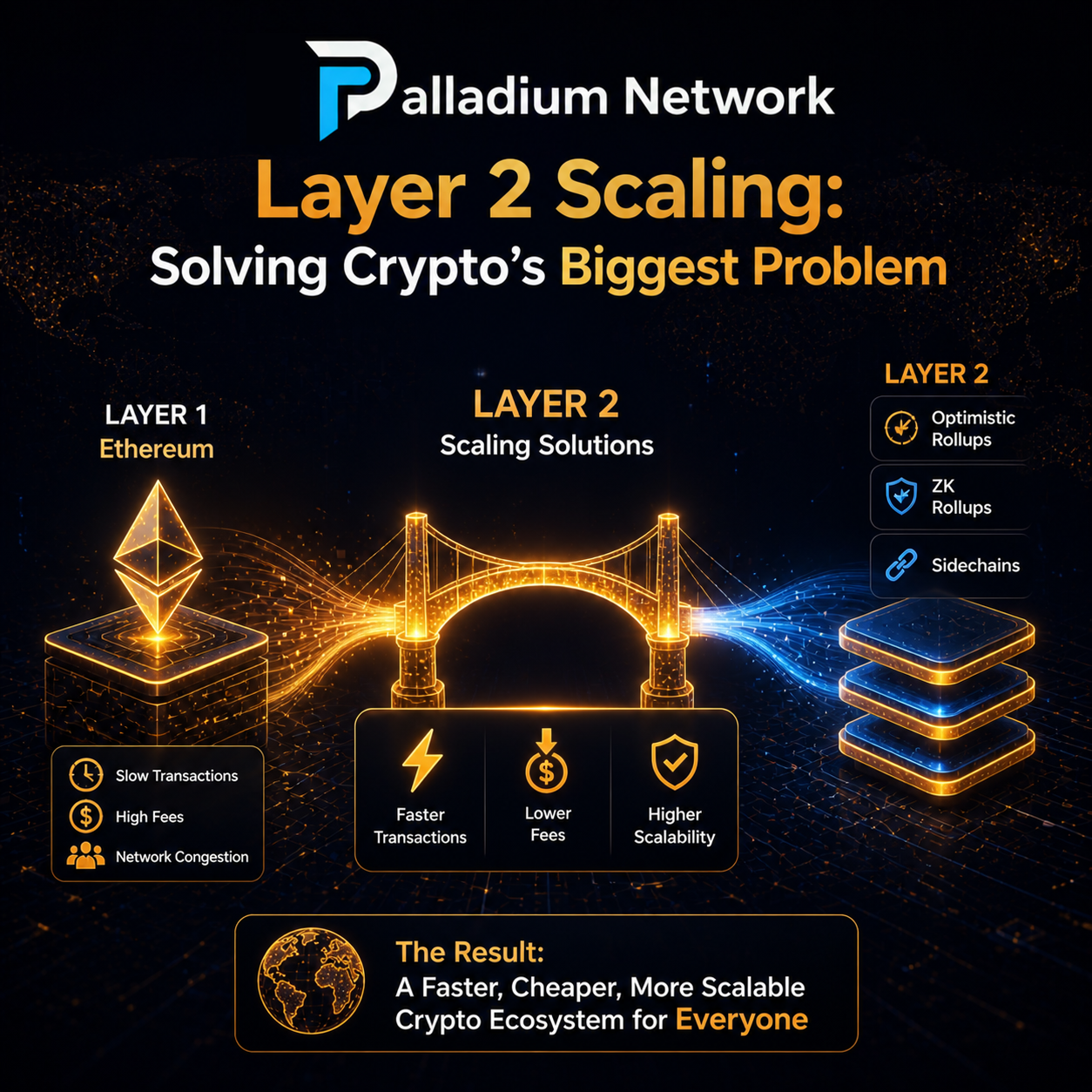
What Is Layer 2?
Layer 2 refers to technologies built on top of existing blockchains (Layer 1) to improve performance without compromising security.
Instead of processing every transaction directly on the main chain, Layer 2 solutions execute transactions in a separate layer off the main chain, which allows for greater processing efficiencies, then they submit the results back to base layer for verification and settlement. The main chain provides security and finality, while Layer 2 delivers speed, scalability, and lower costs.
This approach dramatically improves:
- Transaction speed
- Cost efficiency
- Network scalability
Why Scalability Matters
For crypto to compete with traditional financial systems, it must be able to handle millions of transactions quickly and affordably.
Without scalability:
- Users face high fees during peak demand
- Applications become slow or unusable
- Mass adoption becomes unrealistic
Layer 2 solutions are designed to eliminate these barriers.
Types of Layer 2 Solutions
Several approaches are driving this innovation:
1. Rollups
Rollups bundle multiple transactions into a single batch before submitting them to the main blockchain.
There are two main types:
- Optimistic Rollups
- Zero-Knowledge (ZK) Rollups
Both significantly reduce fees and increase throughput.
2. State Channels
These allow users to conduct multiple transactions off-chain and only settle the final result on-chain.
Ideal for frequent, low-value interactions.
3. Sidechains
Independent blockchains connected to the main network, offering faster and cheaper transactions with different trade-offs.
The Impact on Users
Layer 2 technology is already transforming the user experience:
- Transactions that once cost several dollars now cost cents
- Confirmation times are nearly instant
- Applications become smoother and more accessible
This shift is critical for onboarding millions of new users into the crypto ecosystem.
Powering the Next Generation of Apps
Layer 2 is not just about efficiency—it’s about enabling entirely new use cases.
These include:
- High-frequency trading platforms
- Blockchain gaming ecosystems
- NFT marketplaces with low fees
- Real-time payment systems
Without Layer 2, many of these applications would not be viable at scale.
Challenges and Considerations
Despite its advantages, Layer 2 adoption comes with challenges:
- Complexity for new users
- Fragmentation across different solutions
- Security considerations depending on the model
- Bridging assets between layers
However, continuous development is rapidly improving these areas.
The Future of Scalable Blockchain
Layer 2 is expected to become a standard part of blockchain infrastructure.
In the near future:
- Most users may interact with Layer 2 without even realizing it
- Fees will become negligible for everyday transactions
- Blockchain applications will rival traditional apps in speed and usability
Scalability will no longer be a limitation—it will be a strength.
Conclusion
Layer 2 scaling represents one of the most important breakthroughs in the evolution of cryptocurrency.
By making transactions faster, cheaper, and more efficient, it removes one of the biggest barriers to global adoption.
As the technology matures, Layer 2 will play a key role in transforming blockchain from a promising innovation into a truly scalable global system.
Disclaimer: The information provided in this article is for informational and educational purposes only and should not be considered financial, investment, or trading advice. Cryptocurrency markets are highly volatile and involve significant risk. Readers are encouraged to conduct their own research, verify all facts, and consult with a licensed financial advisor before making any investment or trading decisions.